


 PLATFORM UPDATE:


Mechanistic elucidation of irreversible chemodosimetric sensing of hydrazine through structural, computational, and bioimaging analyses
 *ab
Malay
Dolai
*f
*ab
Malay
Dolai
*f
Abstract
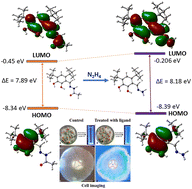
A fluorescent chemodosimeter, DBA, has been developed for the selective detection of hydrazine via an irreversible reaction pathway that leads to fluorescence enhancement. The crystal structure of the ligand has been successfully determined. The sensing mechanism involves the conversion of a hydrazide derivative into a hydrazone derivative, as confirmed by both 1H NMR and mass spectrometry. Upon interaction of DBA with hydrazine, the probe exhibits a significant decrease in absorbance at 366 nm and 279 nm, along with a three fold enhancement in fluorescence intensity at 423 nm, achieving a detection limit of 0.37 µM. The detection mechanism has also been supported by theoretical analysis using density functional theory (DFT) calculations. For practical applications, DBA has been employed in plant-based cell imaging to monitor hydrazine accumulation in Lathyrus sativus L. (grass pea). Overall, DBA is a simple, effective, and promising fluorescent probe for hydrazine detection in diverse fields such as environmental monitoring, food safety, and biological risk assessment.
 Please wait while we load your content...


