


 PLATFORM UPDATE:

Preparation of a porphyrin-based COF functionalized silica-based material as an efficient solid-phase extraction adsorbent for enrichment and separation of bisphenol contaminants
 *a
Wenxin
Ji
a
and
*a
Wenxin
Ji
a
and
Abstract
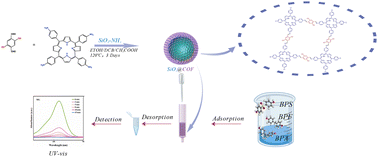
Bisphenols have a wide range of effects on human systems, including the reproductive, immune, and nervous systems, and have been identified as endocrine-disrupting substances. Bisphenols are also ubiquitous in the environment. Therefore, it is of great significance to rapidly and sensitively monitor and detect trace amounts of bisphenols in environmental samples. In this study, a solid-phase extraction (SPE) material—COF-DhaTph@SiO2, with a porphyrin-based covalent organic framework (COF) as the shell and silica as the core—was synthesized via a one-pot method. This material was then applied to the separation and enrichment of three bisphenols (bisphenol A, bisphenol F, and bisphenol S) in real samples. The maximum adsorption capacities for bisphenol A, bisphenol F, and bisphenol S reached 275.73 mg g−1, 252.38 mg g−1, and 122.36 mg g−1, respectively. This can be attributed to the fact that the composite material can form multiple types of hydrogen bonds with bisphenols, while the porphyrin molecules with a large π-system in the composite provide π–π stacking interactions. In addition, conditions such as adsorption time, adsorption temperature, pollutant concentration, and pH were explored and optimized. Under the optimal adsorption conditions, the limit of detection (LOD) values ranged from 0.140 to 1.010 µg mL−1, and the limit of quantification (LOQ) values were between 0.424 and 3.061 µg mL−1. The spiked recovery rates of real samples were in the range of 89.33%–97.33%. After five adsorption–desorption cycles, the maximum adsorption capacity remained above 85%, indicating that the method established using this material is suitable for the enrichment of the three bisphenols in complex samples.
 Please wait while we load your content...


