


 PLATFORM UPDATE:


Perylene functionalized fluorescent zirconium based metal–organic frameworks for selective sensing of Cu2+, Pb2+, and Fe3+ ions
 a
Kettalu Ananthan
Karthick,
b
Tamilselvi
Arunachalam
b
and
Bhaskaran
Shankar
*a
a
Kettalu Ananthan
Karthick,
b
Tamilselvi
Arunachalam
b
and
Bhaskaran
Shankar
*a
Abstract
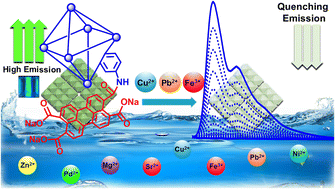
A highly fluorescent amide-linked MOF (UiO-66-NH-PTCDA-Na) was produced by post-synthetically modifying UiO-66-NH2 with the π-conjugated organic linker PTCDA-Na. The structural, optical, thermal, morphological, and surface features were examined by various spectroscopic methods (PXRD, UV-DRS, FT-IR, TGA, XPS, FESEM, and BET). This luminescent MOF was a perfect choice for fluorescence sensing applications since it showed intense cyan emission (λemi = 479 and 514 nm) under aqueous conditions (HEPES buffer, pH = 7.0). The presence of extended π-electron system in the perylene moiety enhances emission, and its amide binding sites enable metal-ion interactions. This strong emission of UiO-66-NH-PTCDA-Na was quenched by Cu2+, Pb2+, and Fe3+, with LOD values of 3.76, 3.14, and 4.31 µM, respectively. Fluorescence lifetime (TCSPC) studies confirmed that dynamic fluorescence quenching occurs due to MOF–analyte interactions. These results showed that this modified MOF (UiO-66-NH-PTCDA-Na) is a promising fluorescence quenching sensor for micromolar level metal ion detection (Cu2+, Pb2+, and Fe3+) in real water environmental systems.
 Please wait while we load your content...


