


 PLATFORM UPDATE:


On the nature of the red shift in absorption spectra of β-dicarbonyl chelates

Abstract
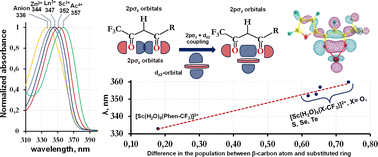
The present work offers a theoretical interpretation of the red shift observed in the absorption spectra of mononuclear dicarbonyl chelates. The energy of the transition ultimately depends on two factors: the redistribution of π-electronic density from a homogeneous distribution around the dicarbonyl fragment toward the multiple bonds of the substituted ring, and the decrease in the interatomic distance between the oxygen atoms of the dicarbonyl fragment. The O–O′ distance is dependent on the coupling between the 2pσz orbitals of oxygen atoms and the dz2 and dxz orbitals of the metal ion.
 Please wait while we load your content...


