


 PLATFORM UPDATE:


Development of a novel GO/Fe@TANG composite electrode for green and sustainable electrosynthesis of N-phenylbenzamides via electrocatalytic carbonylation and hydrogenation
 *b
Abdulrahman A.
Almehizia,
*e
Tulkin
Buzrukov,
f
Gularam
Masharipova,
g
Elyor
Berdimurodov
jklm
*b
Abdulrahman A.
Almehizia,
*e
Tulkin
Buzrukov,
f
Gularam
Masharipova,
g
Elyor
Berdimurodov
jklm
Abstract
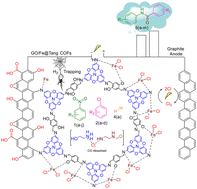
In this study, a novel GO/Fe@TANG composite catalyst was designed by functionalizing graphene oxide (GO) with iron (Fe) and incorporating a hydrogen (H2) trapping TANG COF. This catalyst was evaluated under mild conditions using a multifunctional MEA/EDA DES that serves as a solvent, an electrolyte and a CO trapping agent. The system efficiently catalyzed the electrochemical carbonylation and hydrogenation of various substrates, including nitrobenzene derivatives 1(a–j), chlorobenzene derivatives 2(a–d), monoxide carbon (CO) 3(a), and H2 gas 4(a), to afford N-phenylbenzamide derivatives 5(a–m) in high yields ranging from 91% to 96% under mild conditions (room temperature, 1.5 h, 15 mA). The MOF displayed a high specific surface area of 1105 m2 g−1 and maintained its catalytic performance over 9 consecutive reuse cycles. Extensive characterization techniques such as FT-IR, SEM, TEM, EDX mapping, TGA, BET, 1H NMR, CHN, CV, and XPS confirmed the structural, morphological, thermal, and chemical properties of both the catalyst and synthesized products 5(a–m). This work demonstrates an effective, environmentally friendly electrocatalytic system that integrates iron-based porous materials and multifunctional electrolytes, achieving sustainable synthesis of valuable amide derivatives in a streamlined, high-yielding manner aligned with green chemistry principles.
 Please wait while we load your content...


