


 PLATFORM UPDATE:

Thermal and barrier properties of poly(3-hydroxybutyrate) hybrid nanocomposites: use of experimental data for reliable prediction via machine learning

Abstract
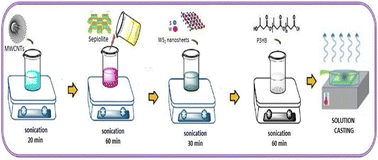
Poly(3-hydroxybutyrate) (P3HB) is a fully biodegradable polyester used for applications such as drug delivery, tissue engineering and food packaging. However, it presents some drawbacks including brittleness, narrow processing window, high water vapour permeability and low thermal stability. The addition of different nanofillers can improve its performance. In this research, P3HB/sepiolite (SEP)/carbon nanotube (CNT)/tungsten disulfide (WS2) hybrid nanocomposites were prepared via a simple, cheap, and ecological solvent casting method. FE-SEM images reveal a good dispersion of the three nanofillers within a continuous matrix. FT-IR spectra corroborate the strong interactions among the nanocomposite components via hydrogen bonding. A synergistic stabilization effect is observed in the hybrids, showing an unprecedented increase in the temperature of maximum rate of weight loss of 125 °C. A very strong reduction in the water vapor permeability and oxygen permeability is also observed for the nanocomposite with 1 wt% CNT, 2 wt% SEP and 2 wt% WS2. Further, two regression methods and different machine learning approaches, namely support vector regression (SVR), support vector machines (SVM), artificial neural networks (ANNs), decision tree (DT) and random forest (RF) have been applied to predict their properties. The correlation coefficient, mean absolute error and mean square error are used as statistical indicators to compare their performance. The best models to predict the barrier properties are ANNs and SVR, while for thermal properties, SVM for classification and SVR for regression showed the most reliable performance. This triple filler strategy is a novel approach to develop hybrid nanocomposites for use in biomedicine or the food packing industry.
 Please wait while we load your content...


