


 PLATFORM UPDATE:


Biochar–silver nanocomposites derived from Borassus flabellifer bark for rapid catalytic reduction of organic pollutants in wastewater

Abstract
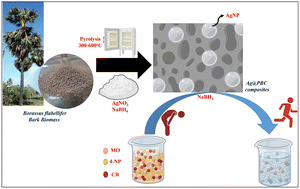
Rapid industrial growth has met human needs but has also led to the contamination of water bodies with persistent and toxic pollutants such as dyes, pharmaceutical waste and heavy metals. Although noble metal-based nanocatalysts have been widely used for pollutant removal, their low efficiency and high cost have prompted the search for affordable and efficient alternatives for wastewater treatment. Biochar-based metal composites have gained significant attention owing to their low cost and effective pollutant removal. In this work, biochar–silver composites (Ag@PBC) were synthesized from Borassus flabellifer bark biomass through pyrolysis at varying temperatures (300–600 °C), using silver nitrate as the source of silver (Ag+) ions. The properties and structures of the materials were extensively characterized using UV-DRS, FTIR, PXRD, XPS, HR-SEM, HR-TEM, and BET. TEM analysis confirmed the deposition of silver nanoparticles (5–15 nm) on the biochar surface. Moreover, the catalytic performance of the Ag@PBC composites was tested for the reduction of 4-nitrophenol (4-NP) to 4-aminophenol (4-AP), as well as the reduction of dyes methyl orange (MO) and Congo red (CR) in aqueous media, with sodium borohydride (NaBH4) serving as the reducing agent. Among the four composites, Ag@PBC 500 exhibited the highest efficiency, achieving the rapid reduction of 4-NP and dyes (MO and CR) within 3 min and 60 s, respectively. The catalytic reduction proceeded efficiently in a mild alkaline medium, with an optimum pH range of 8–11. These results suggest that Ag@PBC composites are promising catalysts for removing nitroaromatic compounds and dyes from industrial wastewater. This study provides an eco-friendly and cost-effective alternative for environmental remediation.
 Please wait while we load your content...


