


 PLATFORM UPDATE:


Fabrication of manganese-loaded lignin-derived carbon via an in situ anchoring strategy for water electrolysis
 ab
Li
Changzhi
*bc
ab
Li
Changzhi
*bc
Abstract
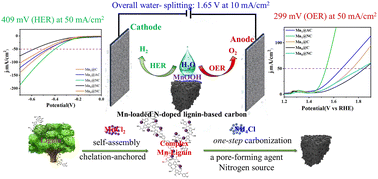
Low-cost, high-performance catalysts are pivotal for advancing water electrolysis toward industrial applications. As an abundant, renewable, and readily available carbon feedstock, lignin offers a sustainable platform for the development of a carbon-supported catalyst. In this study, manganese-loaded lignin-derived carbon (Mnx@C) was synthesized via an in situ chelation–anchoring strategy using lignin as the carbon source. The in situ chelation–anchoring carbonization process enabled effective incorporation and uniform dispersion of Mn species. Mn species in Mnx@C were mainly Mn2O3, MnO2, and MnO. Among these Mn species, MnO was dispersed in the lignin-based carbon support as aggregation nanoparticles, while Mn2O3 and MnO2 were primarily dispersed in an amorphous state. The electrocatalytic performances of Mnx@C were systematically evaluated for the oxygen evolution reaction (OER) and hydrogen evolution reaction (HER). The Mn content and NH4Cl modification significantly influenced the OER and HER activities. The Mn1@C prepared at 1 mmol Mn/g lignin, with the final Mn content of 8.7%, exhibited optimal performances of 517 mV (OER) and 448 mV (HER) at 50 mA cm−2. Further improvement was achieved by modulating the pore structure using NH4Cl as a pore-forming agent, resulting in a Mn-loaded and nitrogen-doped carbon (Mn1@NC). NH4Cl modification induced a morphological transition from a bulk structure to a layered microporous structure with a high surface area. The modified Mn1@NC demonstrated excellent OER and HER performances, requiring low overpotentials of 299 mV (OER) and 409 mV (HER) at 50 mA cm−2. In addition, the overall water-splitting demonstrated a low potential of 1.65 V to reach 10 mA cm−2. This in situ anchoring and direct carbonization strategy provides a simple, cost-effective, and scalable route to high-performance Mn-based catalysts from low-cost lignin, offering potential for industrial water electrolysis and high-efficient utilization of lignin.
 Please wait while we load your content...


