


 PLATFORM UPDATE:


The prone-to-autoxidation nature of morin in alkaline media: mechanisms, kinetics, and implications for cotton bleaching studies
 a
Changhai
Xu
*a
a
Changhai
Xu
*a
Abstract
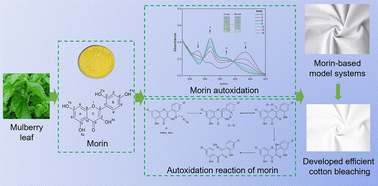
The natural flavonoid morin has strong antioxidant properties but is prone to autoxidation, which restricts its practical application. This is particularly problematic in cotton bleaching research, where its use as a natural pigment model may lead to misinterpretation of bleaching mechanisms. This study aims to systematically investigate the influencing factors and reaction mechanisms of morin autoxidation, revealing its decomposition pathways and kinetic characteristics in alkaline environments. The effects of pH, enzymes, and hydrogen peroxide on the kinetics of the autoxidation reaction are investigated. Thermodynamic analysis and quantum chemical calculations are conducted on the autoxidation process. Additionally, qualitative analysis of the autoxidation products is performed using HPLC-MS, NMR, and FT-IR techniques. It is found that the rate constant of the first-order reaction rises sharply as the pH increases from 9.0 to 12.0. The autoxidation process involves an elementary reaction of electron transfer between morin and molecular oxygen, as well as a redox reaction between the superoxide anion radical and an intermediate state of morin. The autoxidation product of morin is identified as 2,4-dihydroxyphenyl-(2,4,6-trihydroxyphenyl)propanetrione. This work demonstrates that autoxidation is an unavoidable side reaction when using morin as a natural pigment model for cotton fibers in alkaline systems. It also establishes critical benchmarks for assessing the contribution of this reaction to the decomposition of morin in bleaching systems.
 Please wait while we load your content...


