


 PLATFORM UPDATE:


Synthesis and self-assembly of mPEG–palmitic acid and mPEG–stearic acid conjugates for pH-responsive delivery and release of anticancer therapeutics
 d
and
Sabita
Patel
*a
d
and
Sabita
Patel
*a
Abstract
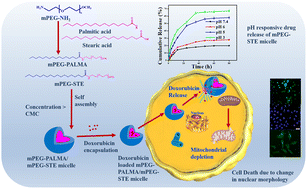
Polymeric micelles have gained significant attention in cancer therapy due to their potential to enhance drug delivery efficiency while minimizing toxic side effects. In this contribution, two biocompatible polyethyleneglycol2000 (PEG) based amphiphiles, mPEG–palmitic acid (mPEG–PALMA) and mPEG–stearic acid (mPEG–STE), have been synthesised by conjugating palmitic acid and stearic acid (featuring hydrophobic alkyl tails C16 and C18 respectively) with PEG through amide linkage and applied for the micellar encapsulation and tumoral release of hydrophobic drug doxorubicin. Both amphiphiles form well defined micelles with CMC in the range of 10–35 µM and within the micellar size of <20 nm. A good degree of doxorubicin encapsulation efficiency (EE) of ∼90% and a drug loading (DL) capacity of ∼9% were determined for both the micelles. From the transmission electron microscopy (TEM), dynamic light scattering (DLS) and differential scanning calorimetry (DSC) analyses, it may be noted that the hydrophobic drug doxorubicin is encapsulated within the micellar core and the stability of the doxorubicin-loaded mPEG–PALMA and mPEG–STE micelles is higher than that of the unloaded micelle, which confirmed a more compact structural arrangement in the presence of the hydrophobic drug. A pH-sensitive release of doxorubicin (faster release with a decrease in pH) is observed for doxorubicin-loaded mPEG–PALMA and mPEG–STE micelles, which is attributed to the diffusion and relaxation/erosion of micellar aggregates. The in vitro drug delivery and anticancer efficacy of both the doxorubicin loaded micelles were studied using SCC9 oral cancer cell lines, which demonstrated that the blank mPEG–PALMA and mPEG–STE micelles were noncytotoxic at lower concentrations (<50 µM), while doxorubicin-loaded micelles exhibited significant cytotoxicity even at very low concentrations of 1–2 nM, attributable to enhanced intracellular delivery of doxorubicin. In conclusion, the mPEG–PALMA and mPEG–STE micellar assembly, with the advantages of good stability, small size, high encapsulation efficiency, simple preparation technique, biocompatibility, and good in vitro performance, may have the potential to be used as a drug carrier for sustained and stimuli-responsive release of the hydrophobic drug doxorubicin.
 Please wait while we load your content...


