


 PLATFORM UPDATE:


Comparative mechanistic study of nitrogen- and oxygen-functionalized activated carbons for dual-phase adsorption
 *ab
*ab
Abstract
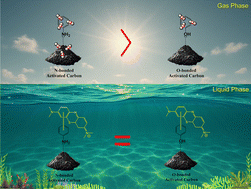
The development of functional adsorbents for the removal of pollutants from both liquid and gas phases is a critical challenge for environmental remediation in the 21st century. Materials that exhibit dual phase adsorption are rare, and less attention has been given to elucidating the molecular level mechanism governing their performance. In the present study, the adsorption of methylene blue (liquid phase) and CO2 (gas phase) was investigated using aniline/phenol-functionalized activated carbon (AC). Both the materials exhibit complete MB adsorption in the liquid phase under ambient conditions. In contrast, aniline-loaded AC demonstrated nearly 2-fold enhanced CO2 uptake (42.8 cm3 g−1 at 298 K, 1 bar) as compared to phenol-loaded AC. X-ray photoelectron spectroscopy analysis reveals that aniline loading on AC preserves the local electronic environment around the –NH2 groups of aniline. This enables stronger quadrupolar interactions with CO2, resulting in higher adsorption capacity. In contrast, phenol loading on AC perturbs the local electronic environment around the –OH groups of phenol. This weakens its interaction with CO2 and lowers the uptake capacity. In the liquid phase, MB adsorption mainly proceeds through π–π stacking. Therefore, the influence of electronic factors is less significant. This study demonstrates the importance of the local electronic environment of loaded functional groups on a solid support in achieving dual-phase pollutant removal. The findings provide molecular-level insight useful for designing next-generation multifunctional sorbents.
 Please wait while we load your content...


