


 PLATFORM UPDATE:


Boric/boronic acid-promoted redox transformation of 4-hydroxy-1,2,3,4-tetrahydroacridine N-oxides to functionalized 2,3-dihydroacridin-4(1H)-ones and mechanistic studies using DFT calculations
 *a
and
Dhurke
Kashinath
*a
*a
and
Dhurke
Kashinath
*a
Abstract
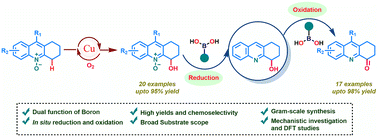
Herein, we have demonstrated the dual functionality of boric and/or boronic acids as reducing agents in the reduction of 1,2,3,4-tetrahydroacridine N-oxides into azaaromatics and as oxidizing agents in the oxidation of benzylic alcohols (C(sp3)–OH) at the C4 position of 4-hydroxy-1,2,3,4-tetrahydroacridine N-oxides into the corresponding ketones, furnishing a series of 2,3-dihydroacridin-4(1H)-one derivatives. The 4-hydroxy-1,2,3,4-tetrahydroacridine N-oxide precursors are synthesized via a Cu-catalysed, regioselective C(sp3)–H hydroxylation of tetrahydroacridine N-oxides under aerobic conditions. This protocol exhibits broad substrate scope and high selectivity, affording dihydroacridinones in excellent yields under mild conditions. The integration of experimental data with density functional theory (DFT) calculations provides valuable insights into the intricate reaction mechanism, shedding light on the dual-reaction pathways facilitated by boric/boronic acids.
 Please wait while we load your content...


