


Mn-, Co-, Cu-, and Cd-substituted Ti2(PO4)3 nanoparticles: optical, magnetic, and photocatalytic properties
 *a
Hossein
Khojasteh
*c
*a
Hossein
Khojasteh
*c
Abstract
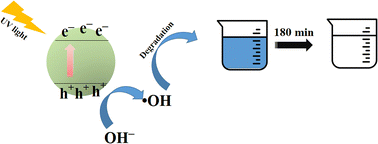
This work reports the sol–gel Pechini synthesis of different M0.5Ti2(PO4)3 nanoparticles (M = Mn, Co, Cu, and Cd). X-ray diffraction (XRD) patterns revealed the rhombohedral crystal structure of the nanoparticles. Further investigation using the Rietveld refinement technique provided tenable data on variations in cell parameters induced by substituting different metal ions. Vibrating sample magnetometer (VSM) measurements were conducted to investigate the magnetic characteristics of the nanoparticles. The obtained coercivity values were 42.5, 113.7, 34.6, and 95.4 Oe for Mn0.5Ti2(PO4)3, Co0.5Ti2(PO4)3, Cu0.5Ti2(PO4)3, and Cd0.5Ti2(PO4)3, respectively. These results implied that the synthesized nanoparticles possess weak ferromagnetic properties. The optical band gap values were determined to be 3.38, 3.53, 3.69, and 3.73 eV for the Cu0.5Ti2(PO4)3, Mn0.5Ti2(PO4)3, Co0.5Ti2(PO4)3, and Cd0.5Ti2(PO4)3 nanoparticles, respectively, showing the potential of the Cu0.5Ti2(PO4)3 nanoparticles to serve as UV-light photocatalysts. The photocatalytic activity of the nanoparticles was studied for the degradation of methylene blue (MB) solution under UV light. The Cu0.5Ti2(PO4)3 nanoparticles exhibited great photoactivity (80.14%) upon 180 min of UV illumination. Reusability experiments showed noticeable stability for all the synthesized nanoparticles. It was found that hydroxyl radicals are the dominant reactive species in the photocatalytic degradation of the MB solution.
 Please wait while we load your content...


