


 PLATFORM UPDATE:


The effect of the nature of supports on the selective reduction of CO2 to CO catalysed by a supported single-site heterobimetallic iron–potassium complex
 *b
Mostafa
Taoufik
*a
*b
Mostafa
Taoufik
*a
Abstract
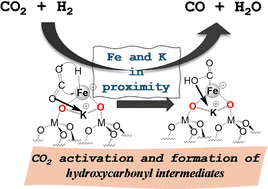
The utilization of CO2 for the production of value-added chemicals has attracted significant interest. Among various strategies, the selective hydrogenation to liquid hydrocarbons via a two-step process, first the reduction of CO2 to CO through the reverse water–gas shift (RWGS) reaction, followed by CO conversion, is particularly promising. In this work, [{(THF)2KFe(OtBu)3}2] is supported on various oxides in order to investigate the influence of the support's properties (neutral, basic, acidic, and redox) on the catalytic performance in the RWGS reaction. A series of catalysts with 1 wt% Fe are synthesized and characterized. Remarkably, catalysts supported on neutral and basic oxides maintain the close Fe–K proximity and exhibit high catalytic activity (conversion around 20%) and full selectivity toward CO (100%). Among these, the FeK/ZrO2-250 catalyst appears to be stable after 40 h on stream, which is supported by XAFS and TEM analyses of the spent catalyst. K+ serves as an electronic promoter, as well as a structural stabilizer of the active Fe site, preventing agglomeration. In contrast, the use of acidic or redox-active supports results in loss of the activity or the selectivity in CO. The formation of methane is attributed to the dissociation of FeK species into Fe nanoparticles and the incorporation of K into the CeO2 lattice or exchange with acid sites of ZSM-5, Nb2O5 or SiO2–Al2O3, thereby disrupting the critical Fe–K synergy. These findings underscore the pivotal role of support selection in preserving the structural and electronic integrity of Fe–K active sites. Supports that inhibit sintering and maintain the FeK single-site configuration are essential for achieving high activity, full CO selectivity, and long-term stability in the RWGS reaction.
 Please wait while we load your content...


