


 PLATFORM UPDATE:


Peptide-induced functionalization of superparamagnetic silver-conjugated iron oxide nanocomposites for enhancing antibacterial activity
 *a
*a
Abstract
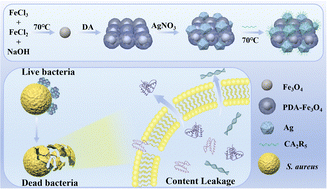
When antimicrobial peptides and nanomaterials are integrated, synergistic antibacterial effects are exhibited. Peptides as ligands have been used to construct ideal antibacterial agents, and herein, peptide-modified silver-conjugated iron oxide nanocomposites were successfully prepared. The formed Fe3O4 core with sufficient magnetic properties via co-precipitation was coated with a polydopamine (PDA) intermediate layer to form Fe3O4@PDA. Due to the groups binding and reducing silver ions in Fe3O4@PDA, an Ag nanoshell with high bacteriostatic activity was deposited on the surface of Fe3O4@PDA to form Fe3O4@PDA-Ag. The synthetic peptide CA2R5 was beneficial for binding with bacterial surfaces through electrostatic interactions, and it was used to modify Fe3O4@PDA-Ag to form the Fe3O4@PDA-Ag-CA2R5 nanocomposite. The Fe3O4@PDA-Ag-CA2R5 nanocomposite produced higher antibacterial activity than the Fe3O4@PDA-Ag nanocomposite, confirming their synergistic antibacterial effect. The minimum bactericidal concentration (MBC) of the Fe3O4@PDA-Ag-CA2R5 nanocomposite against Staphylococcus aureus or Escherichia coli was 0.6 µg mL−1 Ag. The Fe3O4@PDA-Ag-CA2R5 nanocomposite with the same MBC also killed four additional bacterial species (Listeria monocytogenes, Shigella castellani, Salmonella typhimurium, and Pseudomonas aeruginosa). The bactericidal activity of the Fe3O4@PDA-Ag-CA2R5 nanocomposite against S. aureus remained above 80% after five cycles of antibacterial action and magnetic separation. The antibacterial activity of the Fe3O4@PDA-Ag-CA2R5 nanocomposite was stable across different pH conditions (4, 7.4, and 9) and storage time (within 30 days). In the presence of external H2O2, the Fe3O4@PDA-Ag-CA2R5 nanocomposite with high peroxidase (POD)-like activity exhibited a stronger bactericidal performance due to the production of ˙OH. The death of the bacteria was attributed to the disrupted integrity of the bacterial cell. Fe3O4@PDA-Ag-CA2R5 with 6-fold MBC was not toxic to living organisms. The synthesized Fe3O4@PDA-Ag-CA2R5 nanocomposite in our work possessed strong bactericidal ability, broad antibacterial spectrum, satisfactory recyclability, high stability, high POD-like activity, and excellent biocompatibility, thus providing a promising strategy for building robust antibacterial agents.
 Please wait while we load your content...


