


 PLATFORM UPDATE:


First-principles analysis of eco-friendly Sr3BiX3 (X = I, Br, and Cl) inorganic perovskites for optoelectronic applications: a DFT–ML hybrid approach

Abstract
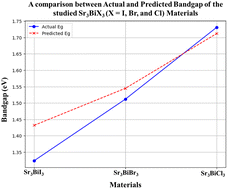
The baseline for photovoltaic and optoelectronic device commercialization was established by non-toxic halide cubic perovskites. In this study, an in-depth exploration of the physical features of Sr3BiX3 (X = I, Br, and Cl) materials was conducted using density functional theory (DFT) due to their immense significance. All the materials are cubic in structure. The GGA-PBE potential functional revealed direct band gaps of 1.324 eV, 1.512 eV, and 1.731 eV for the Sr3BiI3, Sr3BiBr3, and Sr3BiCl3, respectively. Furthermore, the investigated compounds demonstrated remarkable absorption, elevated conductivity, reduced reflectivity, an optimal refractive index, and negligible loss function within the visible light range, making them exceptional candidates for photovoltaic technologies. The Born stability requirements confirmed the mechanical stability of the investigated compounds. In addition, their intrinsic rigidity, strength, resilience, ductility, and anisotropic properties are crucial for enduring performance in engineering contexts. The ab initio molecular dynamics (AIMD) simulations verified the thermal stability of the entitled compounds. These perovskites are experimentally feasible since their phonon dispersion curves have no imaginary portion. To expedite material discovery and bandgap estimation, a machine learning (ML) model was developed using a dataset derived from DFT calculations. The ML-predicted band gaps 1.432 eV, 1.545 eV, and 1.712 eV showed strong agreement with the DFT results 1.324 eV, 1.512 eV, and 1.731 eV for Sr3BiX3 (X = I, Br, and Cl), validating the model's reliability. Moreover, Pearson correlation analysis was employed to explore the connections between structural, electronic, and optical features, providing deeper insight into the key parameters influencing the bandgap. This integrated DFT-ML approach demonstrates a promising pathway for high-throughput screening and design of perovskite materials.
 Please wait while we load your content...


