


 PLATFORM UPDATE:


Comparison of the structure–activity relationship of the bis(imino)pyridine pincers of nickel and cobalt for the electrochemical reduction of CO2

Abstract
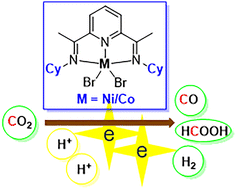
This research presents a comparison of the structure–activity relationship between the cobalt(II) and nickel(II) pincers of a bis(imino)pyridine-based ligand for the electrochemical carbon dioxide reduction reaction (eCO2RR). Cyclic voltammetry of both complexes under 1 atm of CO2 suggested electrocatalytic CO2 reduction activity; however, bulk electrolysis revealed a poor CO-to-H2 ratio in the produced gas. GC analysis of the produced gas mixture from the headspace of the cell revealed the presence of CO and H2 in a ratio of 26 : 74 in the case of the nickel complex and 11 : 89 in the case of the cobalt complex. The nickel complex demonstrated ≈2.37 times better selectivity for CO over H2, in contrast to our bis(imino)pyridine cobalt(II) complex. Formic acid was also obtained as an electrolysis product for both catalysts, along with CO and H2. The selectivity for formic acid was marginally boosted in the presence of our bis(imino)pyridine cobalt(II) complex compared with the nickel(II) complex. The role of the redox noninnocent bis(imino)pyridine backbone in catalysis was investigated through mechanistic analysis based on experimental findings and theoretical calculations.
 Please wait while we load your content...


