


 PLATFORM UPDATE:


Hollow SiO2/MnO2 structures for efficient and stable degradation of phenol and tetracycline under low-oxidant conditions
 *d
*d
Abstract
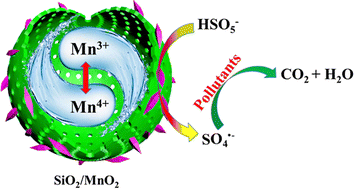
Although MnO2-based materials have been widely employed for the degradation of organic contaminants, their efficacy typically hinges on elevated oxidant concentrations, often as high as 2.0 g L−1. In this study, we engineered a sophisticated hollow SiO2/MnO2 composite, wherein the MnO2 outer layer orchestrates rapid and efficient pollutant degradation through peroxymonosulfate (PMS) activation, while the SiO2 inner core acts as a robust scaffold, enhancing MnO2 dispersion and preserving structural stability. The hollow, porous morphology of the SiO2/MnO2 composite optimizes mass transfer and strengthens catalyst-reactant interactions by minimizing diffusion limitations, thereby markedly elevating catalytic efficiency. Consequently, this hollow SiO2/MnO2 catalyst outperforms commercial MnO2, delivering an eightfold enhancement in phenol degradation rate at a reduced PMS concentration of 0.5 g L−1, alongside a threefold increase in tetracycline degradation efficiency. Liquid chromatography-mass spectrometry (LC-MS) analysis further unraveled the degradation mechanisms of phenol and tetracycline, pinpointing critical intermediates. Collectively, this work presents a pragmatic and highly effective approach to curtailing oxidant reliance in MnO2-based systems, offering significant implications for the design of next-generation materials tailored for organic pollutant abatement.
 Please wait while we load your content...


