


 PLATFORM UPDATE:


Nanofluidic systems for ionic intelligence
 *a
René
van Roij,
b
Ye
Yuan,
c
Md Sifat
Islam,
a
Ryuichiro
Abe,
f
Denis
Garoli,
gh
Ivan I.
Smalyukh
cij
and
Marjolein
Dijkstra
k
*a
René
van Roij,
b
Ye
Yuan,
c
Md Sifat
Islam,
a
Ryuichiro
Abe,
f
Denis
Garoli,
gh
Ivan I.
Smalyukh
cij
and
Marjolein
Dijkstra
k
Abstract
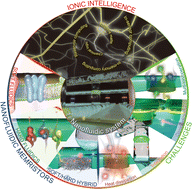
Artificial intelligence is rapidly permeating modern technology, but its growth is increasingly constrained by the costs of delivering power and removing heat. Neural computation offers a striking counterpoint, for it achieves sophisticated information processing at exceptionally low energy by exploiting ionic flows and adaptive conductance. Inspired by the Hodgkin–Huxley view that function emerges from ion-transport dynamics, recent work has begun to implement memory and learning directly in fluids, where ions simultaneously carry signals and encode the internal device state. This Review charts the emerging landscape of fluidic ionic memristors, from soft, bioinspired materials to manufacturable solid-state nanofluidic architectures. In lipid bilayers, droplet networks, tissues and ionic polymers, electrical activity is intrinsically coupled to chemistry and mechanics, enabling plasticity across multiple timescales. In rigid nanopores, nanochannels and angstrom-scale slits, the softness is transferred from the scaffold to the ionic degrees of freedom, where electric double-layer dynamics, concentration polarization and confinement-driven effects produce history-dependent transport in robust inorganic frameworks. Hybrid approaches integrate gels, brushes, particles, or biomolecules within microfabricated structures to combine stability with rich analogue dynamics. We conclude by outlining the key requirements for translation from reproducibility to scalable integration towards ionic intelligence technologies.
- This article is part of the themed collection: Recent Review Articles
 Please wait while we load your content...


