


 PLATFORM UPDATE:


Surface-modified anode current collectors via lithiophilic zinc-based bimetallic co-electrodeposition for lithium–metal batteries

Abstract
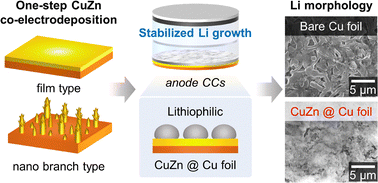
Lithium–metal batteries (LMBs) are considered promising next-generation energy storage systems due to their extremely high theoretical capacity and low electrochemical potential. However, their practical application is limited by the formation of lithium dendrites and poor interfacial stability during cycling. In this study, we propose a scalable CuZn bimetallic co-electrodeposition strategy for modification of current collector surfaces that effectively suppress dendritic growth and enhance cyclic reversibility. Zinc, a lithiophilic metal, was selected as a surface modifier owing to its favorable alloying characteristics with lithium. Substantial differences in standard reduction potentials exist between Cu and Zn, yet we successfully deposited Cu and Zn simultaneously by introducing potassium pyrophosphate into the electrolyte, which modulates the ion activity through complexation. The CuZn morphology was further tuned from flat films to branched nanostructures by controlling the electrolyte composition and deposition voltage. Post-deposition annealing facilitated interdiffusion at the Cu/CuZn interface, resulting in the formation of a recrystallized Cu0.75Zn0.25 alloy and improved mechanical bonding. Compared to bare Cu foils, the heat-treated CuZn current collectors extended the cell lifespan by 44.3% and the nanostructured CuZn further improved it by 87.2%. Electrochemical impedance spectroscopy and lithium nucleation overpotential analysis confirmed reduced interfacial resistance and improved uniformity in Li plating behavior. This work offers a practical and scalable approach for surface modification of anode current collectors for stable and long-life LMBs.
 Please wait while we load your content...


