


 PLATFORM UPDATE:


Functional super-resolution microscopy of fibers and polymers: convergence of artificial and biological systems at the nanoscale
 *abc
*abc
Abstract
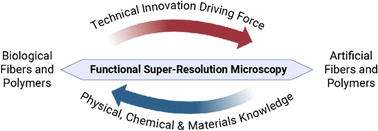
Fluorescence nanoscopy has opened a new frontier for visualizing and understanding polymeric and fibrous materials with molecular precision. Building on advances in single molecule localization microscopy (SMLM), researchers are now extending beyond structure to probe dynamic and functional properties that govern material behavior. This Focus article highlights recent progress in functional SMLM for mapping polarity, viscosity and molecular motion within polymers and fibers, revealing how these nanoscale parameters influence macroscopic performance. Examples include tracking polymerization and phase evolution, resolving nanofiber organization, and correlating structural heterogeneity with local chemical environments. We further discuss the growing convergence between artificial and biological systems with shared principles of hierarchical organization. By integrating structural, dynamic, and functional imaging, fluorescence nanoscopy provides a unifying framework for studying and engineering complex molecular assemblies across living and synthetic matter.
- This article is part of the themed collection: Focus article collection
 Please wait while we load your content...


