


 PLATFORM UPDATE:


Emerging quantitative techniques for characterizing nucleic acid-involved molecular interactions

Abstract
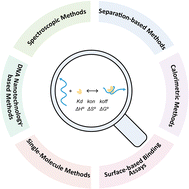
Molecular interactions involving nucleic acids constitute a fundamental paradigm in biological systems, governing processes ranging from gene expression to cellular signaling. Quantitative characterization of the thermodynamic and kinetic parameters of these interactions is critical not only for deciphering molecular mechanisms but also for rational design in biomedical engineering and nanomaterials science. This review systematically surveys six major categories of quantitative methods used to study nucleic acid interactions: spectroscopic methods, separation-based methods, calorimetric methods, surface-based binding assays, single-molecule methods, and DNA nanotechnology-based methods. Each category is discussed with respect to its principal advantages and inherent limitations. While conventional methods such as electrophoretic mobility shift assays (EMSA), isothermal titration calorimetry (ITC), and spectroscopic titrations have provided foundational insights, they often exhibit constraints in sensitivity, throughput, or applicability under physiologically relevant conditions. Recent advances in DNA nanotechnology, leveraging its inherent programmability and structural precision, have enabled the development of novel quantitative platforms. These include DNA origami-based single-molecule methods and homogeneous assays that support accurate and native thermodynamic profiling, significantly enhancing sensitivity and adaptability in physiologically relevant contexts. This review systematically surveys established methodologies and critically evaluates emerging DNA nanotechnology-driven strategies, highlighting their potential to advance the quantitative analysis of nucleic acid interactions.
- This article is part of the themed collections: Recent Review Articles and DNA Nanotechnology
 Please wait while we load your content...


