


 PLATFORM UPDATE:


Green-synthesized gold-coated nanodiamonds as potential radiosensitizers for proton therapy
 ab
Federico
Picollo,
ce
Marta M.
Alves,
fg
Rodica Mihaela
Dinica,
h
Teresa
Pinheiro
*bd
and
Maria Paula Cabral
Campello
*ad
ab
Federico
Picollo,
ce
Marta M.
Alves,
fg
Rodica Mihaela
Dinica,
h
Teresa
Pinheiro
*bd
and
Maria Paula Cabral
Campello
*ad
Abstract
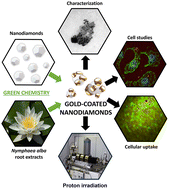
Nanodiamonds (ND) possess unique properties, including high biocompatibility, tunable surface chemistry, and stable photoluminescence, that make them highly attractive for biomedical applications. In this study, we synthesized gold-coated nanodiamonds (NDAu) using a green chemistry route based on Nymphaea alba root extract as a natural reducing agent. The hybrids were produced from two types of ND with median diameters of 50 nm and 230 nm, which were subjected to different thermal treatments prior to the gold coating to modulate their surface properties. The functionalized particles were comprehensively characterized using a combination of spectroscopic techniques (UV-Vis spectroscopy, ATR-FTIR spectroscopy, Raman spectroscopy, PIXE), Powder X-ray Diffraction (PXRD), electron microscopy (SEM and TEM), and zeta potential. These techniques evidenced the impact of the thermal treatments on the NDs, reported the influence of the plant extracts on the final nanoparticles, as well as confirmed and quantified the presence of metallic gold in this material. Moreover, we carried out biological evaluation on A549 lung cell line to assess their cytotoxicity, cellular uptake, and impact on cell survival. Our results confirmed the efficacy of the gold-coating method, elucidating the modifications in particles structural, physical and chemical properties due to functionalization, and the interaction with cells. These nanoparticles could then be used for various biomedical applications, such as drug delivery or as potential radiosensitizers.
 Please wait while we load your content...


