


 PLATFORM UPDATE:

Antibacterial properties and underlying mechanisms of Mo2TiC2Tx and Mo2Ti2C3Tx MXenes targeting Escherichia coli (Gram-negative bacterium)
 *a
Anupma
Thakur,
b
Annabelle
Bedford,
b
Qiaoli
Liang,
e
Mark
Elliott
*a
and
*a
Anupma
Thakur,
b
Annabelle
Bedford,
b
Qiaoli
Liang,
e
Mark
Elliott
*a
and
Abstract
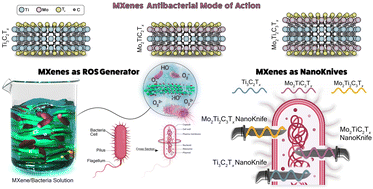
The widespread use of antibiotics has led to an increased number of antimicrobial-resistant (AMR) pathogens, highlighting the need for novel antibacterial nanomaterials with chemical and structural tunability. Here, we present the antibacterial properties/pathways of two molybdenum-based double transition metal (DTM) MXenes (Mo2TiC2Tx and Mo2Ti2C3Tx) and compare them with Ti3C2Tx MXene. We demonstrate that the antibacterial effectiveness of these MXenes is concentration- and time-dependent, with prolonged exposure time being more influential at lower concentration levels (<25 μg mL−1). Physical damage to E. coli cell walls by MXene nanoknives (sharp edges of MXene flakes), and disruption in metabolic functions through oxidative stress were key antibacterial pathways for Mo2TiC2Tx, Mo2Ti2C3Tx, and Ti3C2Tx MXenes. A 1 h sonication of MXene solutions reduced their flake sizes (average lateral size of 234 ± 163 nm) and led to substantial improvement of their antibacterial performance by bolstering the availability of nanoknives for physical damage to bacterial cells. However, prolonged sonication (2 h) resulted in reduced antibacterial effectiveness, potentially due to morphological defects of MXene flakes. We also studied the metal ion release and disc inhibition zone, which revealed no direct correlation between the MXenes’ antibacterial properties and the leaching of ions or fragments. This study demonstrates the potential for improving the antibacterial effectiveness of molybdenum-containing DTM MXenes by controlling their chemical and structural characteristics.
 Please wait while we load your content...


