


 PLATFORM UPDATE:


Tuneable structural and environmental factors for stability of rosette nanotubes
 *abc
*abc
Abstract
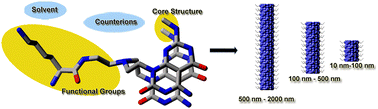
Rosette nanotubes (RNTs) are biocompatible tubular architectures self-assembled under physiological conditions from a self-complementary DNA base hybrid molecule which features the hydrogen-bonding arrays of both guanine and cytosine (G∧C motif). The formation of these architectures is a hierarchical process involving H-bonding and π–π stacking interactions. While motifs possessing either a single, twin or tetra G∧C bases form RNTs, twin RNTs are more versatile due to high stability stemming from intermolecular H bonding interactions, greater preorganization and amphiphilic character and ease of chemical modification. These twin RNTs experience a lower charge density and steric repulsion when functionalized on their outer surface. In order to fully exploit these organic materials which have an intrinsic stability suitable for biomedical and other materials applications, it was necessary to explore the factors that can optimize the self-assembly process and resulting RNT stability. Here we describe the synthesis and characterization of several single and twin G∧C modules that were used to produce self-assembled nanotubes and investigated key environmental and structural factors including solvent, counterions, outer RNT functionalization, G∧C core structure and charge on the self-assembly process.
 Please wait while we load your content...


