


 PLATFORM UPDATE:


DFT investigation of Na-ion interaction with Janus 1T-HfSTe monolayer for sodium-ion battery anodes

Abstract
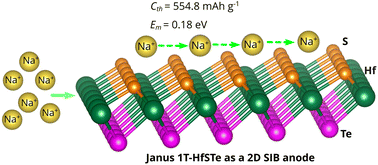
Developing high-performance anode materials with efficient and stable Na-ion storage capability and fast ion-transport kinetics remains a key challenge for advancing sodium-ion batteries. In this work, density functional theory calculations are employed to systematically investigate the Janus HfSTe monolayer as a potential anode material for sodium-ion batteries. The results indicate that the HfSTe monolayer possesses intrinsic metallic conductivity together with good mechanical, thermal, and dynamical stability. CI-NEB calculations reveal low Na diffusion barriers, with a minimum value of 0.18 eV, suggesting favorable Na-ion transport kinetics. Upon progressive sodiation, Na storage proceeds via a layer-by-layer adsorption mechanism, delivering a high theoretical capacity of 554.8 mAh g−1 and a relatively low average open-circuit voltage of 0.33 V, which is suitable for anode operation. Notably, the HfSTe monolayer maintains its metallic character even at high sodiation levels, accompanied by a moderate volume expansion of 10.55%. These results highlight the Janus HfSTe monolayer as a promising anode candidate for high-performance sodium-ion batteries.
 Please wait while we load your content...


