


 PLATFORM UPDATE:

A BiVO4/UU-200 heterojunction for efficient visible-light photocatalytic degradation of rhodamine B
 a
Van Cuong
Nguyen
a
and
a
Van Cuong
Nguyen
a
and
Abstract
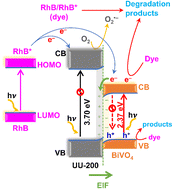
Heterostructured photocatalysts are widely recognized for enhancing charge separation; however, their performance under visible-light irradiation remains limited by inefficient interfacial charge transfer. In this study, BiVO4/UU-200 heterostructured photocatalysts were successfully synthesized via a straightforward solvothermal method. Among them, the 5% BiVO4/UU-200 composite exhibited superior photocatalytic activity, achieving a degradation efficiency of 96.79% for rhodamine B (RhB), compared to 11.85% for pristine BiVO4 and 92.35% for UU-200. The composite also maintained stable performance over three successive cycles. The enhanced activity is attributed to the formation of a heterojunction between BiVO4 and UU-200, which facilitates interfacial charge separation and suppresses electron–hole recombination. Under LED irradiation, the system is proposed to operate via an S-scheme heterojunction coupled with a dye-sensitization pathway, enabling the retention of charge carriers with strong redox potentials. This improved charge separation behavior is supported by photoluminescence and electrochemical impedance spectroscopy analyses. Radical trapping experiments reveal that superoxide radicals (˙O2−), electrons (e−), and holes (h+) are the dominant active species in the degradation process. These findings suggest the role of Bi-MOF (UU-200) as an interfacial charge-transfer mediator and provide new insights into the design of efficient visible-light-driven photocatalytic systems.
 Please wait while we load your content...


