


 PLATFORM UPDATE:


Planar structures of medium-sized gold clusters become ground states upon ionization

Abstract
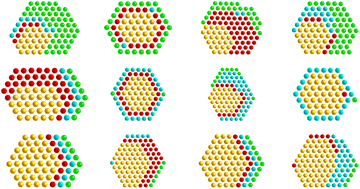
This study investigates the structural stability of ionized gold clusters of sizes ranging from 22 to 100 atoms, contrasting compact, cage and planar structures. While it is well known that neutral clusters in the upper part of this size range predominantly favor compact structures, our results reveal that positively ionized gold clusters exhibit structural transitions in which planar structures become energetically preferred once the charge is sufficiently large. In addition, we study the finite-temperature stability of the structures and find that thermodynamic effects further stabilize planar structures relative to their compact counterparts. To explore the potential energy surface, we use the Minima Hopping algorithm combined with a machine-learned potential. Since the machine-learned potential does not apply to ionized clusters, we introduce a charge-correction term to incorporate Coulomb interactions and charge screening.
 Please wait while we load your content...


