


 PLATFORM UPDATE:


Magnetophoretic transport of functionalised iron-oxide nanoparticles through biomimetic hydrogels and extracellular matrix

Abstract
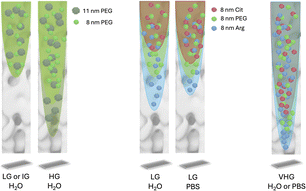
Magnetic nanoparticles show promise for applications including targeted drug delivery, contrast-enhanced imaging, and theranostics, but their efficacy is hindered by limited understanding of nanoparticle–tissue interactions that influence transport through biological tissue under magnetic field gradients. Here, we assess the particle size, surface chemistry, and magnetic field gradient dependence of magnetophoretic transport of magnetic nanoparticles (MNPs) through tissue models of increasing complexity/biological relevance. In all cases linear particle transits were observed through the gels, with progressively increasing velocity for higher gradients. The effect of particle size on velocity is negligible at low and intermediate gradient, but at higher gradient the larger MNPs have higher velocity (p-value 0.002). Scaled velocities, vexp × dhyd, were found to correct for hydrodynamic size-induced differences in drag, enabling identification of MNP–matrix interactions that arise from the particle surface functionalisation used; arginine- (Arg-; positive), citrate- (Cit-; negative) and polyethylene glycol (PEG-; neutral). In agarose vexp × dhyd is higher for Arg- and lower for Cit-, as compared to PEG-MNPs, due to increased and reduced flux, respectively, at negatively charged pore restrictions. This effect is eliminated at very high gradient (pore deformation), or on increasing the ionic strength (reduced electrostatic interactions). In contrast in agarose–collagen hydrogels for Cit-MNPs and particularly Arg-MNPs net attraction to the matrix, due to residual electrostatic interactions with the collagenous component, is evident even at high ionic strength. In ECM relatively slow scaled velocity is observed, despite the open pore structure. Cit-MNPs are particularly hindered, suggesting the residual electrostatic interactions are stronger in this case. The findings contribute to understanding of matrix–particle interactions in models of biological tissue, informing material design for effective MNP transport in targeted nanomaterial-based diagnostics and treatment applications.
 Please wait while we load your content...


