


 PLATFORM UPDATE:


Biomarker-targeted functionalized magnetic nanoparticles: synthesis and aptamer conjugation optimization toward Alzheimer's disease biosensing
 *ab
Konstantina
Kazeli,
ab
Georgios
Katsipis,
cd
Eleni E.
Tzekaki,
cd
Anastasia A.
Pantazaki,
cd
Cristian
Bosch,
e
Ricardo
Simon-Carbajo
e
and
Makis
Angelakeris
ab
*ab
Konstantina
Kazeli,
ab
Georgios
Katsipis,
cd
Eleni E.
Tzekaki,
cd
Anastasia A.
Pantazaki,
cd
Cristian
Bosch,
e
Ricardo
Simon-Carbajo
e
and
Makis
Angelakeris
ab
Abstract
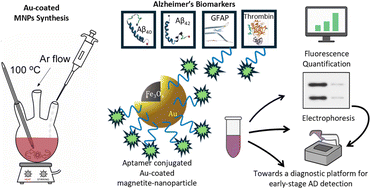
Magnetic-plasmonic hybrid nanoparticles are gaining prominence in biomedical diagnostics due to their dual functionality, combining magnetic manipulation and signal enhancement. A major challenge remains the reproducible synthesis of core–shell nanostructures with controlled size, composition, and stability. In this work, we present a robust two-step aqueous co-precipitation method to produce gold/magnetite nanoparticles, for early Alzheimer's disease diagnosis, based on biomarker's aptamer-based biosensing. Magnetite nanoparticles were first synthesized with high saturation magnetization, followed by controlled gold shell growth via citrate-assisted reduction. Systematic tuning of gold precursor ratios and washing steps enabled precise control over the shell structure and surface properties. The nanoparticles were extensively characterized using X-ray diffraction, dynamic light scattering, zeta potential analysis, vibrating sample magnetometry, ultraviolet-visible spectroscopy, and inductively coupled plasma measurements, outlining optimal characteristics: distinct core–shell morphology, ferrimagnetic behavior, strong localized surface plasmon resonance, and high colloidal stability. Beyond synthesis and characterization of nanoparticles, this study also introduces an innovative aptamer conjugation protocol tailored for maximizing their binding efficiency, thereby enhancing early recognition of certain neurodegenerative biomarkers: Aβ-40, Aβ-42, TBA and GFAP. The tailored features of the gold/magnetite nanoparticles allow fine control over particle size and aptamer loading, making this work a valuable tool for designing structurally, magnetically, and physicochemically optimized carriers for neurodegenerative disease diagnostics. Collectively, these results establish a scalable and functional platform suitable for next-generation biosensing applications in the early detection of Alzheimer's disease.
- This article is part of the themed collection: Magnetic Nanoparticles: From Massart Method to a Cascade of Innovations
 Please wait while we load your content...


