


 PLATFORM UPDATE:


Mo2TiC2/WSe2 nanoarchitectures: in situ grown nanoflowers for efficient hydrogen electrocatalysis

Abstract
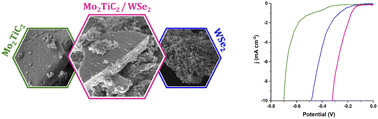
The combination of 2D materials provides a powerful strategy to enhance electrocatalytic hydrogen evolution. Efficient hydrogen electrocatalysis is achieved by interfacing conductive Mo2TiC2 MXene with catalytic WSe2 nanoflowers via a one-step hydrothermal route. The hybrid exhibits low overpotential, fast charge transfer, and long-term stability, outperforming pristine components and establishing Mo2TiC2/WSe2 as a promising hydrogen evolution reaction platform.
- This article is part of the themed collection: Popular Advances
 Please wait while we load your content...


