


 PLATFORM UPDATE:


Metal oxide heterostructures as multifunctional electrode materials for battery-type supercapacitors and oxygen evolution reactions

Abstract
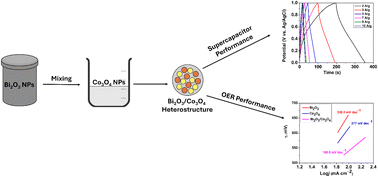
This study demonstrates the successful synthesis of pristine Bi2O3, Co3O4, and Bi2O3/Co3O4 heterostructures for investigating their electrochemical energy storage and electrocatalytic performance. Among all the fabricated electrodes for battery-type supercapacitors, the Bi2O3/Co3O4 heterostructure exhibits a maximum specific capacitance of 2998 F g−1 at 1 A g−1 due to the synergistic interaction between the pristine Bi2O3 and Co3O4 nanoparticles. Furthermore, the Bi2O3/Co3O4 heterostructure was employed as an asymmetric supercapacitor device with a specific capacitance of 237 F g−1 at 2 A g−1. The device exhibited a remarkable energy density of 32.97 Wh kg−1 at a power density of 0.333 kW kg−1. Additionally, the Bi2O3/Co3O4 catalyst displayed increased oxygen evolution reaction rates result in both alkaline and neutral media with very low overpotentials of 464 mV and 153 mV at current densities of 50 mA cm−2 and 10 mA cm−2, respectively. The values of Tafel slope, electrochemical surface area, and charge-transfer resistance confirmed the fast electrode kinetics and high density of active sites. The fabricated electrode exhibited long-term stability when tested for 24 hours under chronoamperometry. These findings indicate that the Bi2O3/Co3O4 heterostructure is an attractive electrode material for energy storage and generation applications.
 Please wait while we load your content...


