


 PLATFORM UPDATE:


Facile synthesis of FeS–Fe3O4 nanocomposites: highly stable & enhanced electrochemical performance in asymmetric supercapacitor applications
 a
a
Abstract
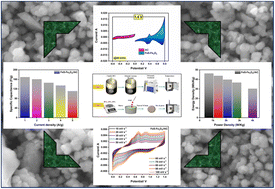
Over the last decade, researchers have required electrode materials that have higher energy density and are highly stable to make the next generation of supercapacitors. This study developed and analyzed a FeS–Fe3O4 nanocomposite as a potential positive electrode material for asymmetric supercapacitors. Structural and morphological analyses were performed using XRD and FESEM, with EDX and EDS mapping. The FeS–Fe3O4 composite worked better than both pure FeS and pure Fe3O4 when tested with a 3 M KOH electrolyte. At 1 A g−1, it has a specific capacitance of 464.6 F g−1, and at 4 A g−1, it has a specific capacitance of 186.9 F g−1. The better performance is because FeS conducts electricity better, and Fe3O4 acts like a pseudocapacitor. These two factors work together to speed up the movement of ions and the redox processes. The supercapacitor fabricated in this work exhibits a unique configuration that has never been reported before. The negative electrode was made of activated carbon, and the positive electrode was made of FeS–Fe3O4. It can work within a voltage window of 1.4 V. The device had a power density of 699.6 W kg−1 and an energy density of 46.10 Wh kg−1. It also delivered a high power density of 3998.4 W kg−1, with a low energy density of 30.17 Wh kg−1. After 12 000 charge–discharge cycles, the device retained 98.6% of its capacitance and about 99.8% coulombic efficiency, which indicates good cycling stability. The results show that the FeS–Fe3O4 nanocomposite is a very good electrode material for energy storage systems that need to be stable and work well.
 Please wait while we load your content...


