


 PLATFORM UPDATE:


Fluorescent nanocellulose derived from Plectranthus barbatus for the selective detection of Pb(ii) ions in aqueous solutions
 *ab
*ab
Abstract
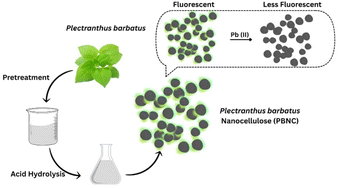
This study reports the synthesis of fluorescent nanocellulose from Plectranthus barbatus and its effective use as a fluorescent probe for the detection of Pb(II) ions in aqueous solutions. Nanocellulose, a nanoscale derivative of cellulose, is used in a variety of applications, such as sensing, food packaging, and biomedical applications, owing to its characteristic properties. In sensing applications, it is mostly used as a support or substrate for the sensing probe. Nanocellulose shows intrinsic fluorescence, which can be harnessed for sensing applications. This underexplored research domain holds significant potential for developing sustainable and cost-effective sensing materials. We synthesized nanocellulose from Plectranthus barbatus (PBNC) and employed it as a fluorescent probe for the detection of Pb(II). To the best of our knowledge, this is the first report demonstrating the potential of fluorescent nanocellulose for metal ion detection. The properties of fluorescent nanocellulose, PBNC, were studied using Fourier Transform Infrared (FTIR) spectroscopy, X-ray Diffraction (XRD), Transmission Electron Microscopy (TEM), and Photoluminescence (PL) spectroscopy. The fluorescence intensity of the nanocellulose was remarkably quenched in the presence of Pb(II) ions selectively. The detection limit (LOD) of Pb(II) using PBNC was found to be 2.7 nM. PBNC is a novel autofluorescent material that functions as an efficient nanosensor for the detection of Pb(II) ions, and its applications can be extended to bio-imaging and sensing in biological, chemical, and environmental samples.
 Please wait while we load your content...


