


 PLATFORM UPDATE:


SERS and SEF with enhancement in nanogaps: from fabrication to biosensing

Abstract
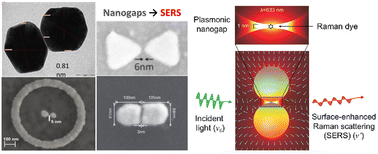
This review surveys SERS and SEF spectroscopies, with a spotlight on the correlation between nanogap fabrication techniques and subsequent applications of those nanogaps in biosensing. In the last several decades, the development of new nanofabrication techniques and novel applications substantially increased the importance of these spectroscopic techniques for biosensing. The cornerstone of this development is the application and control of nanogaps between nanoparticles and nanostructures. Nanogaps are important since they may be responsible for the biggest portion of signal enhancement in SERS and SEF. This review summarizes and provides insights into the theory behind nanogap enhancement, nanogap fabrication, and its applications in direct and indirect biosensing. The theoretical part includes studies on the origin of nanogap enhancement and its dependence on gap distance and agglomeration. Next, the review presents and compares structured and unstructured fabrication techniques with a few dozen examples tabulated with their figures of merit, like the enhancement factor (EF) and limit of detection (LOD). In total, 50 SERS-based and 26 SEF-based articles were tabulated, whereas 38 papers were classified based on the synthesis method and based on the EF and median LOD values calculated for Electron Beam Lithography (EBL) and Template-Assisted (TA) prepared substrates that were no more than one order of magnitude better or about the same as those for other fabrication methods (median 1 × 10⁻¹⁰ and 8 × 10⁻¹⁰ M for EBL and TA, respectively, vs. median 4 × 10⁻⁸ and 1 × 10⁻⁹ M for nanosphere lithography (NSL) and Self-Assembly (SA), respectively). The median EF for substrates fabricated with EBL, NSL, and TA methods (4.6 × 10⁸, 1.0 × 10⁸, and 1.4 × 10⁸) demonstrates only a moderate advantage over the SA technique, with a median EF of 0.3 × 10⁸. However, unstructured nanofabrication techniques like self-assembly have a more affordable price, lower complexity, and better scalability. Therefore, SA can easily compete with ordered nanofabrication techniques. In addition, this review also highlights the applications of nanogaps in label-free detection and biomarker detection. Finally, this review highlights applications of nanogap enhancement in SEF and draws conclusions on the current state of nanogap research and its future.
- This article is part of the themed collection: Recent Review Articles
 Please wait while we load your content...


