


 PLATFORM UPDATE:


Massart iron oxide nanoparticles in mechanobiology

Abstract
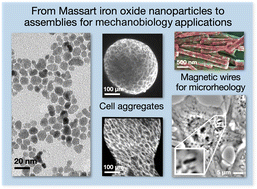
Magnetic nanoparticles (MNPs) derived from the Massart coprecipitation method have played a pioneering role in bridging materials science and biology. Their magnetic moment and nanoscale dimensions have long enabled applications in magnetic resonance imaging, targeted drug delivery, separation technologies, and hyperthermia. Beyond these well-established uses, a growing research direction has emerged at the interface of physics and biology: the application of MNPs in mechanobiology, the study of how mechanical forces regulate cellular and tissue functions. This review examines how Massart MNPs can be used to generate, transmit, and measure forces within living systems. Particular attention is given to interfacial control through advanced surface chemistries, which ensure colloidal stability, minimize toxicity, and preserve the nanoscale integrity of the particles. We also show that the robustness and scalability of Massart synthesis make it ideally suited to the production of biocompatible nanomaterials in quantities required for comprehensive biological studies. Two complementary approaches are discussed. The first exploits MNP assemblies that arise spontaneously within cells, in the form of endosomes. These compartments enable the application of controlled magnetic forces to study both the formation of reconstructed tissues and organoids, and their viscoelastic response. The second focuses on micrometric magnetic wires fabricated from MNPs, used in active microrheology to probe the cytoplasm of living cells over a wide frequency range. Together, these approaches illustrate how MNP assemblies can accurately quantify cellular and tissue mechanics, providing new opportunities for mechanobiological studies and enabling the development of novel readouts of cellular mechanics with potential diagnostic applications.
- This article is part of the themed collections: Recent Review Articles and Magnetic Nanoparticles: From Massart Method to a Cascade of Innovations
 Please wait while we load your content...


