


 PLATFORM UPDATE:


Surface-enhanced stimulated Raman scattering and fluorescence probing of plasmonic nanoparticles in cellular environments: insights into their spatial distribution and aggregation
 c
E.
Rühl
*a
c
E.
Rühl
*a
Abstract
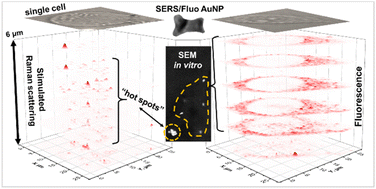
Understanding the intracellular distribution of nanoparticles and their cellular uptake is crucial for advancing their theranostic potential, bridging academic studies with medical applications. This investigation examined the intracellular distribution of gold nanobones (GNB) using advanced imaging techniques by comparing results obtained from confocal fluorescence microscopy and stimulated Raman scattering (SRS). GNB show plasmon resonances in the 600–800 nm range and were functionalized with polyelectrolytes and a cyanine 5.5 chromophore to provide both surface-enhanced SRS (SE-SRS) and fluorescence signals, respectively, while exhibiting low cytotoxicity (IC50 4.85 µg mL−1). They were modified with folic acid for use in the HeLa cell line. Dual SRS/fluorescence 3D single-cell imaging in vitro, supported by scanning electron microscopy, was employed to examine the nanoparticle distribution within single cells, revealing the formation of “hot spots” due to nanoparticle agglomeration. This study underscores the limitations of using GNB for detailed cell imaging and metabolic investigations solely based on either SE-SRS or fluorescence imaging, which is due to the inconsistency of data obtained from either method alone. In contrast, the combined SE-SRS-fluorescence approach revealed detailed information on nanoparticle distribution and clustering within cellular environments, as well as the differentiation of “hot spots”, providing valuable insights into nanoparticle uptake and possible applications in optical diagnostics and molecular biology.
 Please wait while we load your content...


