


 PLATFORM UPDATE:


Thickness-dependent electronic and optical properties of two-dimensional perovskite oxide films: a first-principles study
Abstract
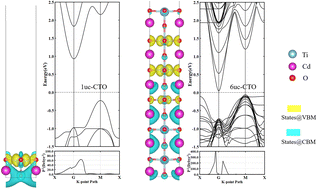
The size effect has a significant impact on the properties of thin film materials; however, relevant research in the field of two-dimensional (2D) perovskite films is not yet sufficient. In this study, the size effects on the electronic and optical properties of 2D CdTiO3 (CTO) and SrTiO3 (STO) films were investigated by first-principles calculations. The results demonstrate that the band gaps of both CTO and STO films decrease as the film thickness increases, and CTO films display unique work function characteristics. Further analysis reveals that the electronic effective mass of CTO films decreases significantly with increasing thickness, while the electronic effective mass of STO films remains relatively stable. Moreover, the electron transition probability of CTO films increases markedly when the thickness exceeds 3 unit-cell layers; conversely, STO films exhibit maximum electron transition probability in the monolayer limit. The reasons for these phenomena can be attributed to the differences in the electronic state distribution and orbital characteristics between the two types of films. Our findings provide fundamental insights into the structure–property relationships and offers theoretical guidance for the rational design of 2D perovskite-based electronic devices.
 Please wait while we load your content...


