


 PLATFORM UPDATE:


Multi-scale computational insights into West Nile virus E-protein adsorption on graphene and phosphorene nanomaterials

Abstract
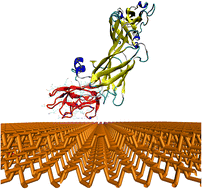
The increasing global impact of flaviviruses highlights the critical need for diagnostic platforms and antiviral therapeutic strategies. In this context, protein–nanomaterial interactions offer valuable opportunities for the rational design of devices with tailored properties. Here, we investigated the adsorption of the West Nile virus envelope protein, specifically domain III, onto two-dimensional nanomaterials, namely graphene and phosphorene, using an integrated multiscale computational approach combining Brownian dynamics docking and extensive molecular dynamics simulations. Docking and MD refinement revealed multiple stable binding orientations on both graphene and phosphorene. On graphene, adsorption is mainly driven by residues in the C–D loop and C-terminal region, involving both hydrophobic and charged interactions. In contrast, phosphorene exhibits more distributed binding, engaging the N-terminal and several loop regions through predominantly polar and hydrophobic contacts, reflecting distinct adsorption mechanisms for the two surfaces. Free energy decomposition confirmed that adsorption on both surfaces is thermodynamically favorable and primarily driven by van der Waals interactions, with phosphorene exhibiting higher stabilization energies. Structural analyses (radius of gyration, solvent-accessible surface area, and secondary structure content) indicate that graphene induces stronger but more disruptive binding, leading to a reduction in β-strand content, whereas phosphorene preserves the protein's native fold and hydrogen-bond network, minimizing structural perturbation. Comparison with experimental data supports these computational findings, suggesting that phosphorene achieves an optimal balance between adsorption strength and structural preservation. These atomistic insights provide a foundation for designing a sensitive and selective phosphorene-based biosensing platform for WNV detection and offer valuable guidance for designing phosphorene-inspired antiviral therapeutic strategies.
 Please wait while we load your content...


