


 PLATFORM UPDATE:

Short metallopeptide conjugate nanostructures for selective cadmium capture and detoxification
 †a
Shruti
Sharma,
†a
Nikunj
Kumar,
b
Ashwini
Waghmare,
c
Bodhisattwa Das
Gupta,
d
Sudipta
Mondal,
d
Puneet
Gupta,
b
Yogesh
Bhargava
*c
and
Khashti Ballabh
Joshi
*a
†a
Shruti
Sharma,
†a
Nikunj
Kumar,
b
Ashwini
Waghmare,
c
Bodhisattwa Das
Gupta,
d
Sudipta
Mondal,
d
Puneet
Gupta,
b
Yogesh
Bhargava
*c
and
Khashti Ballabh
Joshi
*a
Abstract
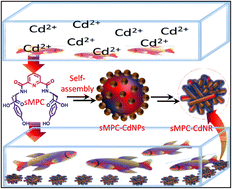
We report a rationally designed biomimetic supramolecular short metallopeptide conjugate (sMPC) that unites sensitive cadmium detection with active detoxification. These cost-effective and biocompatible assemblies respond to Cd2+ by precise metal chelation and stimuli-induced self-assembly, producing a marked fluorescence enhancement for quantification while driving a controlled morphological conversion from cadmium nanoparticles to less toxic nanorods and stabilizing key intermediates. Integrated spectroscopic, microscopic and theoretical analyses reveal the molecular mechanisms of this dynamic organization, advancing fundamental understanding of peptide–metal interactions. Proof-of-concept in vitro (HEK-293) and in vivo-zebrafish-study assays, demonstrate efficient cadmium clearance, mitigation of oxidative stress and cellular recovery. By combining real-time sensing with a built-in detoxification pathway, this human- and environment-friendly nanoarchitectonic platform provides a transformative strategy for heavy-metal toxicity mitigation and opens avenues for next-generation biomaterials in environmental monitoring and intracellular metal detoxification.
 Please wait while we load your content...


