


 PLATFORM UPDATE:


Intrinsic Ohmic contact and electric-field tunable interface in a 2D NbS2/As2C3 metal–semiconductor heterostructure
 †*cd
and
Le Phuong
Long
e
†*cd
and
Le Phuong
Long
e
Abstract
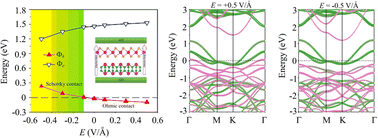
Metal–semiconductor heterostructures play a crucial role in determining the performance of nanoelectronic and optoelectronic devices, as they govern charge injection efficiency and contact resistance at the interface. In this work, we design and explore a 2D NbS2/As2C3 metal–semiconductor heterostructure using first-principles calculations. The heterostructure is confirmed to be energetically stable, with weak van der Waals interactions that preserve the intrinsic characteristics of the constituent monolayers. All stacking configurations exhibit metallic behavior and form intrinsic p-type Ohmic contacts, accompanied by the absence of metal-induced gap states and only weak Fermi level pinning at the interface. The tunneling probability and contact resistivity indicate that the heterostructure exhibits low contact resistance. Furthermore, the interfacial contact behavior can be effectively tuned using an external perpendicular electric field. A positive field reduces the hole barrier while maintaining the Ohmic character, whereas a negative field enhances the barrier and induces a transition to a p-type Schottky contact. These results highlight NbS2/As2C3 as a promising 2D heterostructure with efficient charge injection, weak Fermi level pinning, and electric-field–tunable interfacial properties for future nanoelectronic and optoelectronic applications.
 Please wait while we load your content...


