


 PLATFORM UPDATE:


Thermoelectric and electronic transport properties of thermal and plasma-enhanced ALD grown titanium nitride thin films

Abstract
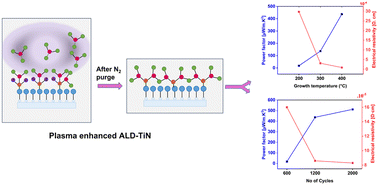
Titanium nitride (TiN) thin films demonstrate high electrical conductivity and thermal stability up to 400 °C in ambient conditions, with stability extending to 600–800 °C under inert or vacuum environments. Unlike many metals and transition metal nitrides, TiN combines high carrier mobility with moderate carrier concentration, making it ideal for thermal management and power-efficient applications in nanoelectronics and energy harvesting. This study systematically investigates the thermoelectric and electronic transport properties of TiN films grown by plasma-enhanced atomic layer deposition (PEALD), comparing them to those produced using traditional thermal atomic layer deposition (thermal ALD). These properties are studied as a function of growth temperature and the number of growth cycles. In particular, TiN films deposited by PEALD at 400 °C for 2000 ALD cycles exhibited a remarkable power factor of 512 µW m−1 K−2 at room temperature compared to a power factor of 4.95 µW m−1 K−2 measured for thermal ALD films fabricated under the same deposition conditions. Additionally, thermal conductivity was also measured for thicker TiN films (86 nm), yielding values of 26.96 W m−1 K−1 for PEALD and 7.01 W m−1 K−1 for thermal ALD, marking the first such report for ALD-grown TiN. These values offer an upper estimate of the thermal behavior in thinner films. Based on these measured properties, the thermoelectric figure of merit (zT) at room temperature was calculated to be 0.0056 for PEALD TiN films which is significantly higher than the value of 0.0002 obtained for thermal ALD TiN films. Our findings provide critical insights into transport properties of TiN, offering guidance for the development of conductive nanolayers in thermoelectric, nanoelectronic, and on-chip cooling applications, where precise control over thermal and electronic behavior is vital, thereby expanding the relevance of ALD TiN in high-performance applications.
- This article is part of the themed collection: Popular Advances
 Please wait while we load your content...


