


 PLATFORM UPDATE:


Strategic tuning of precursor's concentration for the synthesis of Sb2S3 thin films with enlarged nanocrystals and hk1-oriented growth, leading to superior optical properties

Abstract
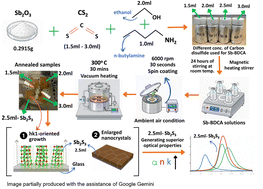
Antimony trisulfide (Sb2S3) has acquired significant attention due to its non-toxic nature, durability, abundance, and superior opto-electronic properties, making it a promising candidate for various applications in optoelectronics and photovoltaics. It is important to focus on achieving the desired crystal morphology and preferred growth (hk1-oriented), as these can potentially result in superior optical properties. Moreover, surface morphology and stoichiometric ratio of the fabricated films also play a significant role. Even after conducting intensive research to address these factors, there remains immense research scope to enhance these properties. In this study, we present a strategically optimized precursor concentration for solution-based synthesis of Sb2S3 thin films with large, compact, homogeneous nanocrystals, hk1-oriented preferential growth and superior optical properties, through a simple, cost-effective spin coating method. By varying the concentration of CS2 (source of sulphur), an enhanced precursor solution was synthesized, which yielded the desirable crystal dimensions, hk1-oriented growth and optical properties. In this research work, we demonstrate the results of varying the concentration of CS2 (from 1.5 ml to 3 ml with steps of 0.5 ml) and the effect it has on the overall structural and optical properties. The synthesized materials were characterized comprehensively using High-Resolution Transmission Electron Microscopy (HR-TEM), Bright-Field Transmission Electron Microscopy (BF-TEM), Selected Area Electron Diffraction (SAED), Scanning Electron Microscopy (SEM), Energy-Dispersive X-ray Spectroscopy (EDS), and Variable Angle Spectroscopic Ellipsometry (VASE). Our experimental findings of BF-TEM, HR-TEM, SAED, and VASE conclude that the precursor solution consisting of 2.5 ml of CS2 was able to generate enhanced nanocrystals, hk1-oriented growth and superior optical properties. The other measurements taken using the characterizing techniques agreed well with the findings of BF-TEM, HR-TEM, SAED, and VASE.
 Please wait while we load your content...


