


 PLATFORM UPDATE:

Sustainable bimetallic Cu/Ni catalysts: leveraging glucose for enhanced immobilization on magnetic Fe3O4/amino natural asphalt composites in coupling reactions

Abstract
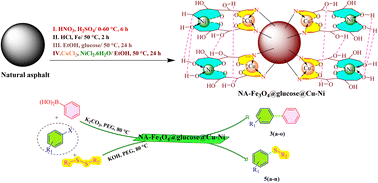
The advancement of magnetic catalytic systems utilizing natural, non-toxic precursors represents a critical need in modern science. In this study, we present an innovative protocol for synthesizing a magnetic bimetallic Cu–Ni complex on a natural asphalt support (NA-Fe3O4@glucose@Cu–Ni), in which glucose plays an important role in influencing the formation of various pentagonal and hexagonal structures in the reaction system. These geometries are likely related to the formation of glucose–metal complexation, which enhances the stability and activity of the catalyst. This catalyst was synthesized as follows: (i) nitration of natural asphalt (NA), (ii) functionalization with glucose as a bioligand, and (iii) immobilization of Cu and Ni ions to form a magnetic bimetallic complex. The catalyst was characterized by FT-IR, XRD, SEM, EDX-Map, BET, TGA, and VSM techniques. This efficient catalyst was used for the synthesis of biaryl compounds and asymmetric sulfides in polyethylene glycol (PEG) solvent at 80 °C, producing products in high yields and excellent chemical selectivity. The reactions were carried out with high efficiency and excellent chemoselectivity. Moreover, the catalyst showed remarkable reusability over six consecutive cycles with negligible loss of activity, confirming its structural integrity and long-term stability.
 Please wait while we load your content...


