


 PLATFORM UPDATE:

Eco-friendly nanoparticles from Fusarium solani suppress biofilms and quorum sensing in Pseudomonas aeruginosa†
 *a
and
*a
and
Abstract
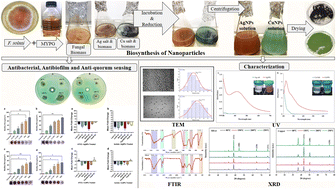
The rise in antibiotic resistance among biofilm-producing Pseudomonas aeruginosa has renewed interest in alternative strategies to fight drug resistance by synthesizing effective and affordable nanoparticles (NPs). In this context, the study aims to assess the antibacterial, antibiofilm, and anti-quorum-sensing properties of biogenic AgNPs and CuNPs against P. aeruginosa. NPs were synthesized using Fusarium solani and characterized through various spectroscopic techniques. P. aeruginosa was identified using the BD Phoenix system and the 16S rRNA gene. The antibacterial and antibiofilm assays were performed using 96-well microtiter plates, and QRT-PCR was adopted to assess the impact of the NPs on quorum-sensing genes. The data of UV–vis spectroscopy clarified the surface plasmon resonance nature of AgNPs at 415–420 nm and CuNPs at 280 nm. SEM and TEM confirmed spherical NPs with average sizes of 17 nm for AgNPs and 21 nm for CuNPs. Additionally, XRD indicated a face-centered cubic structure with crystallite sizes from 18 to 26 nm, and EDS analysis revealed that silver and copper are the major constituents in the nanostructures, with weight percentages of 78.2% and 53.1%, respectively. FTIR revealed the contribution of various functional groups. The MIC ranged from 31.25 to 125 μg mL−1, and the MBC ranged from 125 to 250 μg mL−1. The maximum biofilm inhibition ranged from 53.3 to 84.23%, and the maximum biofilm disruption of preformed biofilm ranged from 51.4 to 76.13%. AgNPs downregulated LasI, LasR, RhlI, RhlR, PqsABCDE, and PqsR genes by 1.4–13-fold, and the CuNPs downregulated these genes by 1.3–11-fold, but PqsR was upregulated by 0.91–2-fold. F. solani mediated AgNPs and CuNPs demonstrated the multi-target action of these NPs and suggest promising avenues for their application as antibacterial and antibiofilm agents against drug-resistant pathogens.
 Please wait while we load your content...


