


 PLATFORM UPDATE:


Microbial synthesis of bimetallic Pd–Rh and Pd–Pt nanoparticle catalysts

Abstract
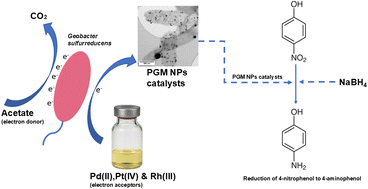
In this study the metal-reducing bacterium, Geobacter sulfurreducens, was used to efficiently recover palladium (Pd), platinum (Pt), and rhodium (Rh) from solution via enzymatic bioreduction to form monometallic or bimetallic bio-PGM nanoparticles. Herein, we report the novel biosynthesis of bimetallic PdRh alloy nanoparticles (bio-PdRh), along with bimetallic PdPt nanoparticles (bio-PdPt). In monometallic solutions, G. sulfurreducens biosynthesised Pd(0), Pt(0), and Rh(0) nanoparticles supported at the cell surface, consistent with bioreduction by outer membrane c-type cytochromes. However, in bimetallic solutions, the cells preferentially bioreduced Pt(IV) over Pd(II), resulting in Pt-rich bio-PdPt nanoparticles and highly dispersed Pd(II) cell-surface clusters. In contrast, co-bioreduction of Pd(II) and Rh(III) led to the formation of PdRh alloy nanoparticles. We hypothesise that differences in the reduction potentials of the metal complexes were key to forming these different nanostructures. The reduction of 4-nitrophenol was used to assess bionanoparticle catalytic activity. Monometallic bio-Pt and bio-Rh displayed low activity for this reaction, whereas bio-Pd nanoparticles were highly active and gave the fastest initial reaction rate. Bimetallic bio-PdPt and bio-PdRh catalysts performed comparably to bio-Pd, using half the Pd content. This work highlights the ability of metal-reducing bacteria to synthesise functional nanocatalysts while recovering precious metals from mixed metal-containing wastewaters.
 Please wait while we load your content...


