


 PLATFORM UPDATE:


Performance of ultrafine silver chromate particles in electrochemical capacitors for low-pass frequency filtering applications

Abstract
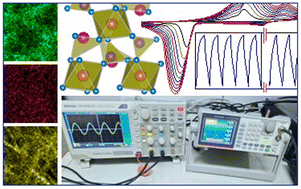
Electrochemical capacitors or supercapacitors have become a prominent area of research in energy storage because of their extended cycle life and rapid electrochemical performance along with significant energy and power density. This report provides a comprehensive synthesis and analysis of silver chromate (Ag2CrO4) nanoparticles and investigates their electrochemical performance as an electrochemical capacitor. Ag2CrO4 is a chemically stable material that exhibits high electrical conductivity and low solubility, making it an ideal candidate for supercapacitor applications. Nanosized Ag2CrO4 was synthesized using an organic molecule mediated complexation route where particles ranging from 10 to 30 nm in size are encapsulated within the organic matrix. For the Ag2CrO4-based three-electrode system, at a scan rate and current density of 5 mV s−1 and 3 A g−1, the specific capacity values obtained were 131 and 203C g−1, respectively. An asymmetric supercapacitor device was fabricated utilizing Ag2CrO4 as the cathode and activated carbon as the anode material, which displayed a specific capacity of 36C g−1 at 0.4 A g−1 and 31C g−1 at 10 mV s−1. The assembled device displayed a maximum power density of 361 W kg−1 at an energy density of 1.5 Wh kg−1. The performance of the device was successfully demonstrated by powering a red LED, confirming its capability as an energy storage component. Furthermore, the ability of the device to attenuate high-frequency signals was demonstrated through its integration into a resistor–capacitor (RC) circuit, where it operated as a low-pass filter, emphasizing its potential for use in frequency-selective electronic applications.
 Please wait while we load your content...


