


 PLATFORM UPDATE:

Advanced metal–support interactions in Cu/ZnO catalysts: the role of MOFs and ZrO2 for enhanced methanol production
 *a
and
Masoud
Safari Yazd
*a
*a
and
Masoud
Safari Yazd
*a
Abstract
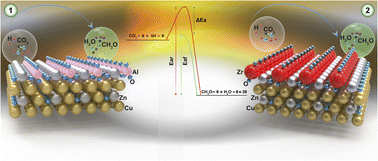
This study explores the role of metal–support interactions (MSI) and the incorporation of Metal–Organic Frameworks (MOFs) in enhancing the catalytic performance of Cu/ZnO-based catalysts, promoted and supported by Al2O3 (ANC) and ZrO2 (ZNC), for CO2 hydrogenation to methanol. The ZNC catalyst exhibits significantly superior catalytic performance, achieving up to 90% methanol selectivity and 28% CO2 conversion under optimal conditions. These improvements are attributed to its higher dispersion, better reducibility, and stronger metal–support interaction (MSI), facilitated by the incorporation of ZrO2. The use of MOFs in the catalyst synthesis contributes to enhanced stability and active site dispersion. The MSI, coupled with the presence of ZrO2, facilitates hydrogen spillover, oxygen vacancy formation, and improved CO2 and H2 activation. DFT calculations corroborate experimental findings, revealing ZNC's lower activation energy barriers and more efficient pathways for methoxy intermediate formation. This study highlights the critical role of MSI and MOFs in optimizing catalytic efficiency, establishing ZNC as a promising candidate for sustainable methanol production.
 Please wait while we load your content...


