


 PLATFORM UPDATE:


Valley splitting and anomalous valley Hall effect in MoTe2/CrSCl heterostructure
 *a
*a
Abstract
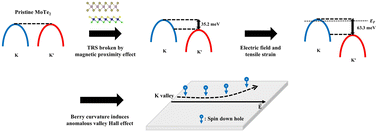
Two-dimensional valleytronics offers a promising platform for novel information processing and quantum technologies by harnessing the valley degree of freedom. A key challenge lies in lifting valley degeneracy, for which magnetic proximity effects provide a promising route. Here, we demonstrate substantial valley splitting in a MoTe2/CrSCl heterostructure via first-principles calculations. We show that interlayer charge transfer and interfacial orbital hybridization critically govern the valley physics at the interface. Under a moderate in-plane tensile strain (3%) and an applied out-of-plane electric field (0.2 V Å−1), a sizable valley splitting of 63 meV emerges at the valence band maximum. These conditions induce hole doping and a pronounced Berry curvature of −23 Å2 at the K valley, realizing an electrically tunable anomalous valley Hall effect. Our findings establish the MoTe2/CrSCl interface as a versatile platform for valley-selective charge transport, opening pathways for valleytronic device applications.
- This article is part of the themed collection: Popular Advances
 Please wait while we load your content...


