


 PLATFORM UPDATE:

A catalytic hairpin amplification platform triggered by near-infrared light and logic assembly for sensitive detection of microRNAs
 b
Mingyuan
Chen
*e
b
Mingyuan
Chen
*e
Abstract
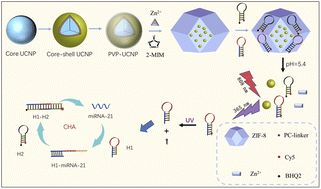
Research has shown that miRNA-21 levels increase during vascular aging, making it a promising biomarker for vascular aging. Therefore, developing sensitive miRNA-21 detection techniques is crucial for early diagnosis, therapeutic intervention, and prognosis assessment of vascular aging. This work developed an enzyme-free fluorescence sensing platform based on upconversion nanoparticles (UCNPs) and a catalytic hairpin assembly (CHA), which uses 808 nm light-controlled switches and fluorescence resonance energy transfer (FRET) signal regulation for highly sensitive and specific quantification of miRNA-21. First, the loaded DNA hairpins and the UCNPs were released under weakly acidic conditions due to the disintegration of the organic framework material (ZIF-8). Under 808 nm irradiation, when the analyte miRNA-21 is present, the DNA hairpin (H1) undergoes specific unwinding, triggering CHA, leading to signal recovery of the fluorescent group on another DNA hairpin (H2) and quantitative detection of miRNA-21. The degree of fluorescence restoration of the sensor exhibited a good linear correlation with the miRNA-21 concentration in the range of 0.5–25 nM, and the limit of detection reached 0.128 nM. Moreover, this method exhibits excellent analytical performance in the detection of serum samples, with spiked recovery rates ranging from 98.2% to 102.8%. These data demonstrate that the light-controlled sensing platform has significant merits, such as high detection sensitivity, strong specificity, and minimal background interference, providing a reliable method for the rapid quantification of miRNA-21 in complex matrices.
 Please wait while we load your content...


